
DevRel Engineer - Documentation
SigNoz
This job is no longer accepting applications
See open jobs at SigNoz.See open jobs similar to "DevRel Engineer - Documentation" SignalFire.About SigNoz
SigNoz is an open-source observability platform that helps developers monitor, trace, and debug their applications fast. Today we serve users in 30+ countries , have 23k+ GitHub stars , a 7,000-member Slack community , and 180+ OSS contributors —all while operating as a fully remote, globally distributed team. We’re YC-backed and supported by leading Bay-Area VCs.
What You’ll Do
-
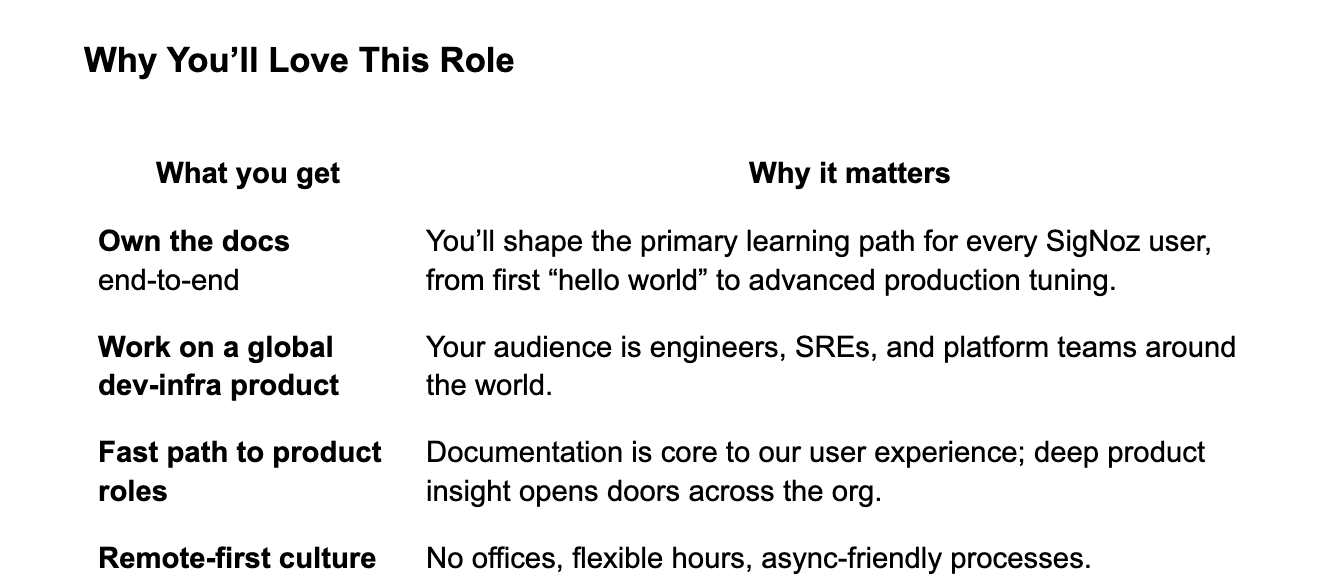
Own SigNoz documentation. Set the structure, tone, and information architecture; keep it accurate as the product evolves.
-
Deep-dive into code & config. Reproduce user setups, debug issues, and translate findings into clear docs and examples.
-
Create onboarding flows & tutorials. Write step-by-step guides, sample apps, and troubleshooting playbooks that turn first-time users into power users.
-
Partner with Engineering & Product. Review PRs for doc impact, champion doc-first thinking, and surface user feedback.
-
Engage with the community. Answer questions in Slack/GitHub, identify doc gaps, and turn common pitfalls into solutions pages.
You Might Be a Great Fit If You…
-
Have 2+ years in an SRE, DevOps, Platform, or similar technical role.
-
Can read and debug at least one of Go, Python, or JavaScript (we use all three).
-
Learn new tools quickly and love untangling complex distributed-system problems.
-
Write crisp, developer-friendly prose and enjoy explaining why as much as how.
-
Are customer-obsessed —delighting users and removing adoption blockers motivates you.
Nice-to-Haves
-
Experience maintaining docs for an OSS project or SaaS product.
-
Familiarity with OpenTelemetry, ClickHouse, or Kubernetes.
-
Previous contributions to technical blogs, conference talks, or tutorials.
Who Probably Won’t Thrive Here
-
Candidates fresh out of college without hands-on ops / dev experience.
-
Writers who prefer purely editorial work without diving into terminals, repos, and PRs.
Success Looks Like
-
New users can instrument an app, send data to SigNoz, and run their first trace in <15 minutes—guided by your docs.
-
Support and community questions drop as self-service answers go live.
-
Release cycles include clear, timely doc updates because you’re embedded in the dev workflow.
This job is no longer accepting applications
See open jobs at SigNoz.See open jobs similar to "DevRel Engineer - Documentation" SignalFire.